

The State of the Market – Winter 2025
With 2025 already delivering two official cash rate cuts, there’s been a lot of talk about what lower interest rates will mean for the property market.
Will it see house prices increase? Will it spur on investors? And what about first-time buyers? Will more affordable lending see them re-enter the market?
Well, with the second 25 basis point cut delivered in late May, it’s a little too early to tell, but let’s take a quick look at the trends emerging, including what tends to happen in the property market over winter.
Cash rate cuts
After peaking at 4.35 per cent in November 2023, this year has delivered the interest rate cut that borrowers and mortgage holders have been hoping for.
In February, the Reserve Bank announced the first cut of 0.25 per cent, followed by a further cut at the recent May meeting.
That now sees Australia’s official cash rate sitting at 3.85 per cent, which adds a little extra to the household budget of those with mortgages. It also creates a little extra affordability when it comes to lending and bolsters a sense of improved consumer confidence.
CoreLogic notes as a result of the latest rate cut, the average variable rate for outstanding owner-occupier loans is expected to fall to around 5.81 per cent, reducing repayments on a $750,000 loan by approximately $81 per month.
House prices
Just when pundits predicted the market can’t go any higher, Australian property prices continue to defy the odds.
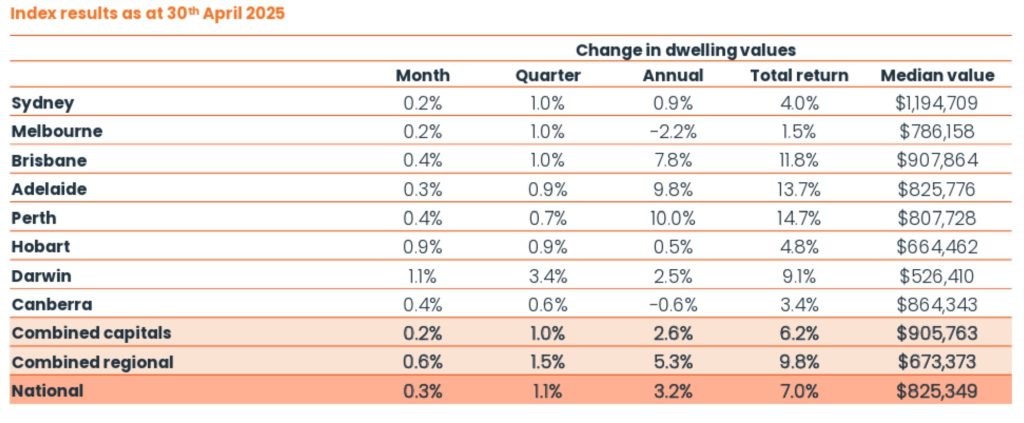
Despite a Federal election and the economic uncertainty generated by US trade tariffs, property values hit a further record high in April, with dwelling values rising 0.3 per cent, according to the CoreLogic Hedonic Home Index.
That added about $2720 to the median value of an Australian dwelling, taking the median national property home value to $825,329.
Source: Corelogic
Much of that increase was driven by the smaller capitals and also regional areas, which have recorded not just monthly gains, but significant annual gains over the past 12 months.
For example, CoreLogic’s April data indicates Perth dwelling values increased 10 per cent in the 12 months to April 30, Adelaide rose 9.8 per cent, and Brisbane increased 7.8 per cent.
Meanwhile, regional WA was up 13.2 per cent, regional SA rose 12.9 per cent and regional Queensland was up 8.7 per cent.
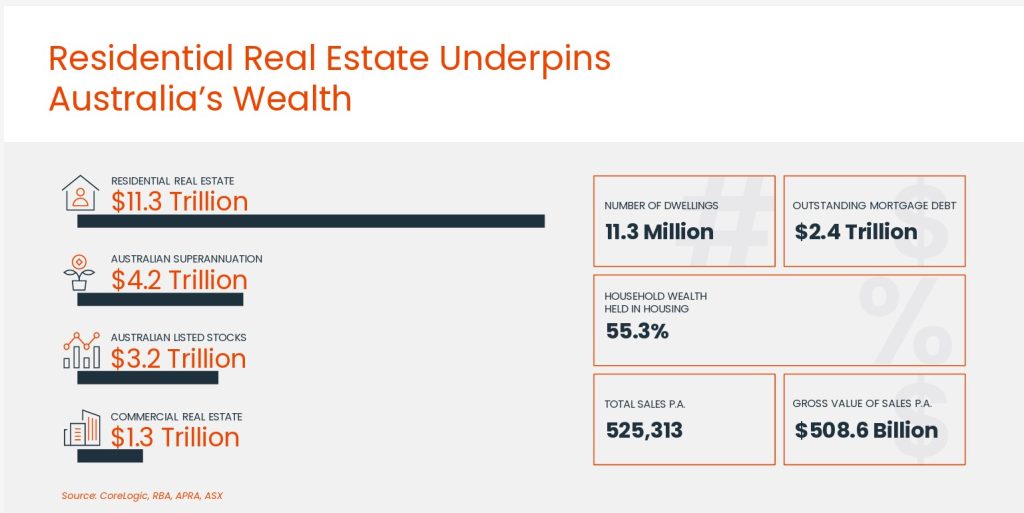
Those increases now see Australian real estate valued at an astounding $11.3 trillion.
To put that in context, that’s more than twice the value of Australian superannuation and over three times the value of wealth funnelled into Australian stocks.
In fact, an astounding 55.3 per cent of Australian wealth is currently held in Australian residential real estate.
Source: CoreLogic
Typical winter trends
As autumn makes way for winter, the property market tends to cool along with the weather, with listing volumes dropping as fewer sellers bring their properties to market.
And there is an obvious reason this is the case. In southern states, winter isn’t the most ideal time to showcase a home, particularly when it comes to lush green gardens and bright sunny days.
The big question is, will this year stay true to that trend? Because, interestingly, last year didn’t.
In mid-July, 2024, PropTrack noted that new listings on realestate.com.au in June were up nationally by 1.3 per cent compared to the same time in 2023, and in the combined capital cities, there were 5 per cent more listings to choose from.
This year, there’s talk those recent interest rate cuts and increased consumer confidence may also see sellers keen to take advantage of stronger selling conditions. So potentially, we could see more properties come to market than is typical for this time of year.
Supply versus demand
An area where uncertainty did have an impact earlier in the year was property sale volumes, which took a dip in April due to the election and US trade tariffs combined with affordability constraints and multiple public holidays.
CoreLogic notes April’s estimated sales volumes dipped to 37,774 nationally, taking the annual count of 525,313 to its lowest result in nine months.
That said, the 12-month estimate of national sales remained 2.7 per cent above the levels seen in April last year and 3.0 per cent above the previous five-year average.
Meanwhile, a key metric indicated buyer demand was actually on the up, with the time it takes to sell a property reducing nationally.
Despite being higher than the same time last year, days on market continued to reduce in April, with the national median time on market dropping from a high of 36 days over the three months to February to 33 days over the three months to April.
“Across the capitals, Darwin, Melbourne, Sydney and Canberra recorded the steepest declines compared to the three months to February, down -13, -11, -10 and -8 days, respectively,” CoreLogic said.

Source: CoreLogic
Auctions
The auction market paints a telling picture of sales volumes and buyer sentiment, with the clearance rate offering a key indicator of just how confident sellers are and also how keen people are to buy.
Heading into the first week of June, auction volumes were on the rise, with 2816 capital city homes scheduled for auction over the first weekend in June, which was up from 2460 the week proper and 2380 this time last year.
In Sydney, the first weekend of June was slated to be the third busiest auction day of the year, while in Melbourne, it was expected to be the fourth busiest week of the year to date.
Meanwhile, the clearance rate is also on the rise, with the latest interest rate cut given much of the credit for renewed confidence.
The week ending May 26 saw the preliminary clearance rate increase to 71.3 per cent, marking the second most successful auction weekend of the year.
What’s the takeaway?
With a Federal election, world economic challenges, and general uncertainty, the past few months have been interesting to say the least.
But despite the headlines, the Australian property market is holding strong. That uncertainty has been balanced by recent interest rate cuts which have instilled a new sense of confidence in property and the general economy.
What we’re seeing overall is a solid market, where sellers can still achieve good prices, but borrowing conditions are becoming more conducive to buying.
But of course, Australia doesn’t have a one-speed property market. It’s local. If you’re considering selling or buying, that makes now a great time to reach out to a local expert to find out what exactly is happening in your area.